Professional Genre Weirdo
"When the going gets weird, the weird turn pro"
- Hunter S. Thompson
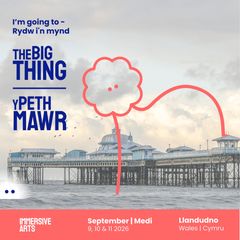
I attended the Immersive Arts conference The Big Thing in Llandudno on the 9-11 of September. It's a conference devoted to the design, production, and staging of immersive work. The looseness of the term gives space to a wide range of experiences, most of them using technology in some way. So there was a lot of VR, some projection, immersive theatre, and art installations straddling the gaps.
There were many interesting talks but the one I've been thinking about the most was by Quintin Smith (known as Quinns) - a YouTuber, games journalist, and new arrival to this corner of the immersive world - called A house called play. His talk focused around the experiences he thought we weren't payihg enough attention to, despite their massive size and fan base - especially Nordic Larp and Jubensha. He emphasized he'd also given this talk to games people, and his point wasn't to call out immersive artists specificially, but to fight against the tendency for people to become stuck in the self-built prisons of genre and format, unable to learn or experiment with techniques outside our experiences. We weren't in the immersive industry, we were in the play industry.
The idea that we work in play makes intuitive sense to me; I have the bad habit of wandering into other people's industries without realising it. I came into immersive from books via immersive theatre, an accidental byproduct of my work on the Digital Ghost Hunt. When I started the Digital Ghost Hunt I wasn't entirely sure what I was making, but I knew its root was the playground games dreamed up by bored eight year-olds at lunch. I used whatever terms seemed to make sense to the most people at the time -- it was immersive theatre, but then we had these ghost detectors I'd built, which meant it was sort of like Augmented Reality, but there weren't any screens so it didn't really look like it to anyone working in XR. When I started developing a new experience during the pandemic, I reached for Unreal and some elements of video game design, because that was the tool that seemed right. I started referring to what I was making as an escape room because it had some of that puzzle feeling now that there were game elements. I finally started calling it a live action video game. I don't know if any of these terms were right, or if I will have to call my work something else tomorrow.
Mixing all these forms and ideas together sounds fun (it is fun,) but there is a cost. On a panel at a separate event, game designer Meghna Jayanth said she felt like she was making games for an audience 20 years in the future. Everyone wants to be "ahead of their time," but only safely in hindsight. When you're doing it in the present, people don't know if they want to fund you or come see your experience, or even how to find it. Since my time and attention is spread over several different silos - books, immersive, games of several different kinds - I've found it difficult to be part of the communities that sustain them. I have often felt like a professional genre weirdo, never in the right space at the right time.
The internet doesn't help as much as it should because we are encouraged to think only in algorithm keywords and hyper-specific niches. Fall through the cracks in those keywords, and you turn invisible. Unless, someone finds your work and champions it. It was really heartening to hear from Smith that, although he'd gone from covering video games to tabletop games to experiences of all descriptions, his audience had stayed with him. They had trusted that he wanted to show them something that was worth their attention and their time.
All genres stagnate as soon as they are named; all niches are shallow graves. We have to be willing to climb over those walls and hope other people will follow us. We may not like what we find - we absolutely do not have to. But we might like the next thing, though, or the next. Even things I dislike have often taught me interesting things about why I dislike them.
The truth is that we are almost never as ahead of our time as we think we are. There is usually someone else who is a step ahead of you connecting the dots or just behind, waiting for you. This is a good thing. We are all speaking dialects of the same language: play.